Wednesday, September 3, 2008

Snide

I just forced myself to watch the second night of the truncated Republican National Convention, mainly so I could see the mysterious Sarah Palin speak. Ms. Palin--I guess that, in order to avoid the charge of sexism, I really should refer to her by her title as Governor Palin--has been thrust upon us so suddenly and unexpectedly by the Republican spin machine, and subsequently so hidden away to avoid having to answer all those pesky questions from the press about who she is, that at this point she has become something of a complete mystery. She has been plucked from almost complete obscurity to become the most controversial and talked-about candidate for high office in recent memory. Tonight was her night on the national--and international--stage. I had to see her perform.

What I saw was not encouraging. Gov. Palin described herself as a pit bull with lipstick. I think that's a pretty accurate description. Maybe George W. Bush in stiletto heels would be more accurate. The entire tone of her presentation could most accurately be summed up by the word "snide." That word is defined by the online dictionary I use as "derogatory in a nasty and insinuating manner." Other descriptions of her speech (and the others I forced myself to sit through tonight) would be "cynical," "deceptive," "sarcastic," and "dishonest."


Gov. Palin actually reminds me of a horrid girlfriend I had in my late 20's who stole some of my family heirlooms (two violins that had belonged to my grandfather). She managed to get away with it through skillfully evasive fast talking and implied threats of a lawsuit for slander. She was very sexy, very smart, and very sneaky. I couldn't pin anything on her, because she claimed I had "given" them to her when I had actually committed them to her safekeeping upon her promise to have them repaired. When I asked for them back, she claimed either that they had been lost, or that she believed I had intended to give them to her. In fact, she had sold them. This charmer was the spitting image of Gov. Palin in looks, voice type, manner, and even political views. (Yes, I confess to having had a torrid affair with a Republican. In my defense, it only lasted 3 months. Anyway, it served me right. Live and learn.) From what I've heard about Gov. Palin's style of governing Alaska, she might as well be the same person as my former girlfriend.

And in order even to get to Gov. Palin's snide little spee
ch, I had to sit through Mitt Romney, Mike Huckabee and Rudy Giuliani, listening to them vie with each other on who could out-pander to the most extremist right-wing authoritarian wing of what in the past 8 years had already become an extremely right-wing authoritarian political party. I mean, what is it with Mitt Romney attacking the last 8 years of George W. Bush as having been too "liberal"?? And attacking Democrats as the Party of "Big Brother," as if it wasn't his own Republican Party which has brought this country warrantless domestic wiretapping, extradition, torture, suspension of the Great Writ of Habeas Corpus, politicization of the Justice Department, and grotesquely expanded presidential prerogative? As I watched the roaring approval given by the overwhelmingly white male Republican delegates to these hyperventilated appeals to the extreme right, it occurred to me that Gov. Palin has given the Republican Party just what it most needs in this election: a smiling, unthreatening, "small town," superficially attractive "happy face" to mask its frighteningly hard-edged authoritarianism.

The Republican Party has painted itself into the most extreme right-wing corner it has ever occupied in our history. If, as Romney, Huckabee and Giuliani seemed to claim, the last 8 years have been too "liberal," and the Supreme Court as presently constituted has been too lenient on civil liberties, I shudder to think of the fate of our country if these thugs get into office. In order to prevent that disaster from occurring, those of us who still cherish democracy and, yes, true republicanism, must fight for the election of Barack Obama and Joe Biden as President and Vice-President, and contribute as much as we can in time, toil and treasure to their campaign. The fate of our country demands nothing less.


Monday, August 11, 2008

Ashland in July (part four)

A View from the Bridge

On our second day in Ashland (July 30), we saw Breakfast, Lunch and Dinner in the afternoon (at the New Theatre) and The Comedy of Errors in the evening on the Elizabethan Stage. This was unfortunate. Not only were these the two worst productions (in my opinion) of the entire season, but it also happened to be my birthday! It was very nice, therefore, that both the productions we saw on the next day were so good -- in fact, two of the very best of the entire season. I have already described that evening's play, Othello. The afternoon production was of Arthur Miller's A View from the Bridge, a play with which I was not familiar. It's a wonderful piece, and the OSF has given it a fantastic production.

The quality of the production starts off with the director. This is the one play directed this season by former OSF Artistic Director Libby Appel. She is a superb director, and very dependable. Everything I've seen by her has been excellent, and this particular production was no exception.

A View from the Bridge was written in 1955, almost exactly in the middle of both the last century and Arthur Miller's career as one of America's most distinguished playwrights. Like all good plays, including Miller's, it tells a story at once localized and universal, time-specific and timeless. Eddie Carbone (Armando Duran) is a second-generation Italian-American longshoreman living in the crowded Italian dockside section of Brooklyn, New York, in a cramped apartment with his wife Beatrice (Vilma Silva) and her niece Catherine (Stephanie Beatriz). Beatrice is pressuring Eddie to do two things he doesn't want to do: first, give his consent to letting Catherine quit school and go to work as a secretary to a local plumbing company; and second, permit two of her cousins from the Old Country to stay in their apartment while they look for work and lay low to avoid the immigration authorities. Eddie reluctantly agrees to both of her desires, which lead ineluctably to the tragic outcome of the play. We gradually learn that Eddie is deeply attached to Catherine emotionally as something between a surrogate daughter and an unattainable mistress. The arrival on the scene of Beatrice's cousins Marco (David DeSantos) and Rodolpho (Juan Rivera LeBron) immediately complicates everything. Marco's old country machismo and pride come into violent conflict with Eddie's similar traits, while the blossoming romance between Rodolpho and Catherine drives Eddie to distraction with his misplaced jealousies and increasingly paranoid projections.

I don't want to spoil the plot any further for those who, like myself, may be unfamiliar with the play. So I'll leave off describing it by stating that it ends badly for almost all concerned. Suffice it to say that the story unfolds in a seemingly timeless way, like some classic Greek tragedy transplanted to mid-century urban America.

This production was perfect in every respect. Armando Duran was so wonderful in the central role of Eddie Carbone that he will be permanently branded in my memory every time I think of this play. His performance was so real, so moving, so utterly genuine that he made me absolutely believe he was the second-generation Italian-American longshoreman he was portraying. Hopelessly tormented by his impossible feelings toward Catherine, and deeply torn between those feelings and his loyalty both to Beatrice and to his community, Eddie's very Sicilian sense of omerta clearly distinguishes him from another Miller tragic hero, the pathetic, end-of-the road Willie Loman in Death of a Salesman. Duran's total commitment to the role was obvious. He was Eddie for the duration of the play.

Duran was not the only standout performance in this play. This was one of those OSF productions in which every single role was distinguished by superb acting. Vilma Silva is apparently incapable of bad acting. Everything I've seen her in has been memorable--Emilia in Othello, and last season both Katherina in Taming of the Shrew and Vera in Distracted. (I can only regret not having had the opportunity in past seasons to see her as Viola in Twelfth Night and as Isabella in Measure for Measure, two great roles for which she would be perfect.) The amazing thing about Silva's Beatrice in this particular play was how completely she disappeared in the character. Silva perfectly conveyed Beatrice's emotional quandary, torn between the conflicting loves and loyalties in her life. At intermission, I was stunned to realize I had seen the same actress in an amazing performance as Katherina just last year. Needless to say, the two roles are utterly different in character.

Newcomer Stephanie Beatriz was similarly perfect in her characterization of the critical role of Catherine. Beatriz very persuasively portrayed the budding and dangerously naive adolescent caught, like the other principal characters, between conflicting loves and loyalties--in her case, between Eddie and Rodolpho. Neither did David DeSantos or Juan Rivera LeBron disappoint as the two immigrant cousins, Marco and Rodolpho; both were completely convincing.

Mention must be made of the reliable Tony DeBruno in the key role of Mr. Alfieri, the community lawyer. DeBruno is a workmanlike actor who never disappoints. Here, DeBruno made Alfieri--who fills the role in the play of narrator or Greek Chorus--a truly sympathetic character, the one person with whom the audience could most readily identify. He rounded out the outstanding cast in this truly astonishing production of the closest thing to a classic Greek tragedy I know of in American theater.

Postscript

There were two other plays that we saw on this visit: Breakfast, Lunch and Dinner by Luis Alfaro, and--for the second time--The Further Adventures of Hedda Gabler by Jeff Whitty. You can see my rave review of the latter here, dating from our first visit to Ashland this season. Suffice it so say that both Judy and I loved this amazing play even more on second viewing than we did the first time. That's saying a lot, since we loved it so much the first time that we decided to plunk down the big bucks to see it on our second visit to Ashland, forcing us to drive home late at night and arrive back in S.F. close to midnight. It was worth every penny just to see Robin Nordli, Kimberly Scott, Kate Mulligan, Gregory Linington, Anthony Heald and Jonathan Haugen on stage running through this hilarious yet improbably serious masterpiece again. We picked up a whole lot of references and jokes we had missed the first time, which was great. If you are going to Ashland, do NOT miss this production.

As for Breakfast, Lunch and Dinner--well, there's really not much to say, regrettably. According to the program notes, playwright Alfaro is the recipient of numerous honors including awards from the National Endowment for the Arts, Theatre Communications Group and PEN USA, two Kennedy Center awards for New American Plays, and a MacArthur "Genius Grant." Those awards could not have been for this particular play. Despite its generally good cast (the standout was the ever-wonderful G. Valmont Thomas as the central character's husband), it left us--and the rest of the audience at the performance we saw--scratching our heads and wondering just why OSF had decided to produce it.

What after all can you say about a play in which the food-addicted central character keeps putting on weight until she turns into a balloon and floats away, happily leaving her loving husband behind even though he has been totally supportive of her despite her weight "problem"? That's about all that happens, aside from a subplot about the lady's oversexed, narcissistic sister and her "I can't commit" LAPD boyfriend. Don't tell me this play is supposed to be a metaphor about the importance of love and caring for each other. There are many much, much better plays on that subject. We actually saw some of them this season. (Viz.: Our Town, Othello, The Further Adventures of Hedda Gabler, Midsummer's Night Dream, The Clay Cart, and A View from the Bridge.) They are all far better than this mess of a play. (If you don't believe me, check out this New York Times review. Different production, but definitely the same play we saw.)

Sunday, August 10, 2008

Ashland in July (part three)

Othello

In view of how disappointing the production of Comedy of Errors was this season, the good news is that the production of Othello was its opposite in every way. The play, and all of the actors in it, were as breathtakingly perfect as could be hoped.

If you're reading this blog, I will assume your familiarity with this particular play. Although not quite on the level with Hamlet and King Lear, Othello is still one of Shakespeare's most popular tragedies, not least because Verdi wrote his greatest opera using the story and Shakespeare's own text (in italiano, naturalmente.) (If you are unfamiliar with Shakespeare's play, I highly recommend seeing one of the several versions on film or video, either with Orson Welles, Kenneth Branagh & Laurence Fishburne, or Anthony Hopkins & Bob Hoskins.) After the performance we saw of the current OSF production, I've decided the play is now one of my favorites.

Any production of Othello stands or falls on the casting of the two central roles. In this respect, the OSF production is a winner. In the title role is Peter Macon, a newcomer to Ashland with a resume loaded with extensive experience in Shakespeare at numerous other companies. Macon's Moor was attractively honest, honorable, strong and virile from the start, with no obvious flaws where Iago's poison might work its way. In Macon's performance, Othello was too self confident and in love with Desdemona to fall victim to jealousy right away. One could see Macon weighing Iago's insinuations carefully, rejecting them out of hand at the outset, and refusing to give them credence until it appeared absolutely necessary to do so. This is no mean feat, in light of the relatively short span of time Shakespeare gives in the text before Othello does fall prey to jealousy under Iago's tutelage. I like this interpretation of Othello. The more it seems to the audience that Othello will be able to see through Iago's lies and retain his confidence in himself and in Desdemona, the more the inherent tension of the action and the ultimate tragic outcome of the play are heightened.

The other key role, of course, is Iago. The first half of the play really belongs to Iago; in many ways, he is the principal character until the moment that Othello succumbs to jealousy. This production benefits from one of the most perfect actors to play this role I could imagine. Anybody who knows Dan Donohue's work at OSF will know instantly what I mean. Last season he gave Caliban a creepily nonhuman, subterranean quality in The Tempest, and invested his Mercutio with such frighteningly manic energy that one suspected some of the Veronese youth in the ambiguously modern production of Romeo and Juliet had been experimenting with illegal substances. All of these qualities are appropriate to Iago as well, to be sure, and were certainly present in Donohue's portrayal.

But Donohue's was a perfectly calibrated reading with no hint of overacting or forced "villainy." To the contrary; his Iago's soliloquies were understated and quietly conversational as though he was making his plans up as he went along and inviting the audience along to help him work them out, rather than arriving on the scene as a fully formed villain to inform us of his carefully thought-out plan for vengeance. This was an almost creepily realistic interpretation, in that it made the audience feel complicit in what Iago was doing until it was too late to stop the terrifying chain of events. It was as though we were watching a truant boy playing with matches and combustibles without being able to stop him, while simultaneously becoming increasingly fascinated by his potential for senseless arson and wanton destruction. Get the idea? It gave me chills while I watched it. It still does! I found myself actually gasping audibly at key moments, even though I'm well familiar with the play and the text.

Iago's foil, Cassio, was well played by Danforth Comins. Cassio is not a particularly deep or complex character, but Comins made him interesting and sympathetic. I should mention that Comins is absolutely riveting and superb as the title character in this season's Coriolanus, a play which no afficiado of either the OSF or Shakespeare should miss. (See my earlier review, here.)

The only slightly weak point in the production, from my perspective, was the Desdemona of Sarah Rutan. Her reading was a bit too contemporary for my taste, both in inflection and in the "I am woman, hear me roar" style of her acting. Call me old fashioned, but I think the tragedy works better if Desdemona is more gentle and feminine than strong and willful. Think Juliet rather than Katherina. It is then all the more horrifying that Othello should fall prey to Iago's insinuations and suspect her virtue. On the other hand, Vilma Silva's Emilia--Iago's long-suffering wife--was flawless. (Silva, of course, was the incredibly magnificent Katherina in last season's Taming of the Shrew.) Christopher DuVal was a wonderfully hapless Roderigo.

Ashland in July (part two)

The Comedy of Errors

The second production we saw on the Elizabethan Stage was of a play purportedly by Shakespeare. Unfortunately, it wasn't at all glorious. Director Penny Metropulos has mounted a high concept production of Shakespeare's only farce, setting it in the American West of movie myth and indeterminate date. The production comes complete with actors giving their lines in irritatingly grating Texas accents and breaking into musical comedy songs at the drop of a ten gallon hat. For the first time at Ashland, I (almost) walked out at the intermission.

What's the problem with that, you may ask. After all, I wrote a good review of this year's Midsummer's Night Dream, which did a very similar thing by setting that comedy in a radically updated and very hip contemporary "fairy land." Well, in fact all of this Wild West schtick would be perfectly OK with me if it wasn't for one very big thing. And that thing is, that a very great deal of this Comedy of Errors production wasn't Shakespeare at all. At least half the lines read or sung by the actors, including most or all of the song lyrics, sure as goll durn don't come from the pen of no dang Shakespeare dude, dag nab it. (That last sentence had several more or less direct quotations from this Penny Metropulos "adaptation," just for flavor. Can you find them?) That was most obviously the case of the lines spoken in Spanish, and delivered by a character identified as Jose Luis who doesn't appear in any Shakespeare play with which I am familiar. Certainly not The Comedy of Errors. And Jose Luis wasn't the only newly invented character to appear in this production, either.

The one good thing about reviewing a production as annoying and misdirected as this is that I don't feel compelled to spend much time or effort writing about it. Listing the actors who did their parts well just isn't worth the effort. For one thing, in view of the heavy handed schtick, added lines, ridiculous accents, and phony dialectical changes to the text with which they had to wrestle, it was impossible to tell whether they were actually doing their parts well. I will nevertheless mention that several of my favorite OSF performers were in this production -- notably, Tasso Feldman and John Tufts as the two Dromios, Emily Sophia Knapp as Luciana, David Kelly as "The Colonel, a mine owner" (Angelo the goldsmith in the original), and Armando Duran as "Doctor Antonio Pitch, a snake-oil salesman" (Dr. Pinch in the original). Those individuals all did superb jobs laboring under the unnecessary burdens imposed on them by their director and the additional lines and lyrics composed by her and others. I can't speak for the other actors I saw on stage. I will simply assume that the campy performances they gave were the director's fault, and not theirs.

That's about all I have to say on this production, except that The Comedy of Errors is one of my favorite comedies, and I had been very much looking forward to seeing this one. I was therefore pretty pissed off at witnessing the way a ham handed director could ruin a perfectly good farce by loading it up with schtick and anachronisms beyond its limits of endurance. Simply put, Metropulos succeeded in draining the humor, the real comedy, and most of the laughs out of the play by forcing it to fit the silly concept she was determined to impose on it. I'm sure Shakespeare could have written a very funny farce about people like such directors, all too common nowadays. Unfortunately, it's becoming increasingly necessary to distinguish between productions of the real Shakespeare, and misbegotten pastiche productions like this one, cobbled together from a cannibalized Shakespearean text and pop culture cliches. Pity the poor dead Bard.

Saturday, August 9, 2008

Ashland in July (part one)

Judy and I returned to Ashland in July to see the rest of the season. (See my earlier reviews from our trip in May, here, here, here, here, and here.) We stopped off in Ashland on our way north to Portland, via Bend and Mt. Hood's Timberline Lodge, and then stopped off again on our way back south to San Francisco. This time around, we managed to see the remainder of the season, including the following plays: Othello; The Comedy of Errors; Our Town; A View From the Bridge; and Breakfast, Lunch and Dinner. We found these five productions to be a mixed bag, with three of them of the very highest quality, one quite problematic, and one a real dud. (We also saw The Further Adventures of Hedda Gabler again, just for fun.) Here are my reviews.

Our Town

We saw Thornton Wilder's Our Town presented on the outdoor Elizabethan stage on our first night. Our Town is a perfect play to perform in this setting, and it is a wonderful production. Although set with great specificity in Grover's Corners, New Hampshire, starting on May 7, 1901, and superficially presenting in the simplest possible manner the principal life events in two village families (Gibbs and Webb), Wilder's play is actually timeless and universal. The action very simply recounts the everyday events of life and death in those families, objectively and yet sympathetically, without a trace of false sentimentality or mawkishness. We watch the characters grow up, fall in love, marry, age and pass away into death. As we do so, Wilder gently leads us to see that each and every moment of our seemingly ordinary lives is so fleeting and hemmed in by the inevitability of death as to be infinitely precious. The play is nothing less than a meditation on the most fundamental question of existence: whether there is any meaning or purpose to human life and death in the context of an apparently impersonal universe. In simplest terms, Wilder's answer is that life is defined by the inevitability of death; and that life is therefore given meaning by the extent to which we really live it. If we can become as observant and attentive as possible to each moment of the everyday miracle of existence, and stop taking the things or people of life for granted, the meaning of life takes shape in the very living of it.

The program notes from the relatively young immigrant Asian-American director Chay Yew recount how he considered Our Town "sentimental and dull" when he first encountered it in an "Introduction to Theatre" class, and later walked out of a regional theatre production, "bored and unaffected," when he was still in his 20s. When Oregon Shakespeare Festival artistic director Bill Rauch asked him if he was interested in directing the play in Ashland, Yew was naturally "apprehensive." Upon rereading the play, however, he found himself "at a loss for words--profoundly moved, awed and in a quiet joy" at the play's simple timelessness.

The director's confession rang quite true for me, for two reasons. First, it matched my own experience of the the play, which I found annoyingly cloying when I had to read it in high school. Second, in this new production as directed by Yew, I had the same experience reported by the director: a realization that the play was not sentimental or nostalgic, but actually quite moving and even profound. Yew's newly gained insights obviously enabled him to mount a production that brought Wilder's own intentions clearly to the fore.

The casting is completely color-blind, which greatly enhances the universality and humanity of Wilder's message. The amazingly versatile Anthony Heald--last year's Tartuffe, and an incredibly hilarious retro-queen in this year's Further Adventures of Hedda Gabler--serves as the foundation of all the action as the Stage Manager. I couldn't imagine a better actor for this key role. Heald's Stage Manager is warm, yet brisk; no nonsense, but with a gentle twinkle. All the other actors are similarly first rate. Particularly deserving mention are Richard Howard and Kimberly Scott as Mr. and Mrs. Webb. I loved the way these two actors melted so seamlessly into their characters that by the middle of the play one no longer noticed that Howard is a rather pale white man and Scott a dark complected African American.

And in that unconscious, subtle melting away of the superficial distinctions of skin color, the central message of Our Town was given substance: a message of universality, boundlessness, timelessness, and profound humanity. This production, so beautifully presented, made it clear just how great a play Our Town is. It truly deserves to share the glorious Elizabethan Stage with the works of Shakespeare for which that stage was built.


Friday, July 18, 2008

What Would John Do?


This wonderful piece of creative fluffery appeared on Talking Points Memo's "TPM Café Talk" today, and I cannot resist pointing readers in its direction. It is entitled "Arguments in Favor of the Election of Senator Barack Obama to the Office of the Presidency," and purports to be written by one "President John Adams."

If you know me, you know my personal affection for, nay, identification with the second President of the United States. (See here.) Far be it from me to claim that I could ever claim to possess this Founding Father's great qualities. To the contrary, I must confess to have more than my share of old John's foibles -- irascibility, overly-passionate intensity of opinion, pig-headedness, etc. etc. My admiration for him sprang originally from having portrayed him twice in the musical comedy "1776," which forced me to "inhabit" him as much as I could as an actor. As a (hopefully) good actor, I read a lot about him and his times, and learned as much as I could about what made him tick.

It was President John Adams who said "great is the guilt of an unnecessary war." Adams was speaking specifically of a potential war with France, for which members of his own party (the now long-defunct Federalist Party) were agitating with great enthusiasm. Adams considered his successful avoidance of war and negotiation of a peace treaty with France the greatest accomplishment of his Presidency. For obvious reasons, the sentiment expressed by Adams was never more powerfully appropriate than it is today, when this nation is suffering under the financial, psychological, moral, and all-too-mortal burdens of a totally unnecessary war of choice in Iraq. This is only one of several historical statements by Adams which are of peculiar relevance in the contemporary America of President George W. Bush. (Another one is this: "[A] Constitution of Government once changed from Freedom, can never be restored. Liberty, once lost, is lost forever.")

So I read with more than a little pleasure this post on TPM today. It purports to bring us, from beyond the grave, the endorsement by John Adams of Barack Obama for President. Obviously, it's quite tongue-in-cheek. But a great deal of it strikes me as quite astute, and historically informed. (I have no idea who actually wrote it.) The specific points he makes are that Obama: (1) is best placed to reach "past the perniciousness of faction," i.e. end as much as possible the intense polarization in our current Fox/Rove infected politics; (2) end both the endless (and phony) "War on Terror" and the maleficent so-called "Bush Doctrine" of "preemptive" war for the extension of empire; and (3) restore the Bill of Rights, the separation of constitutional powers, and the separation of Church and State. The piece concludes with an amusing reference to Abigail's wish to communicate some words of commiseration, solace and encouragement to Hillary Clinton, which Adams informs us he told Abigail to communicate to the "Inter-Net" on her own.

Please read the piece yourself -- it is amusing and yet touching. I just wish I'd had the wit to write it myself. But then, I'm not really John Adams.

Thursday, July 3, 2008

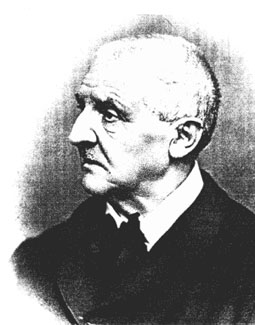
Bruckner


Bruckner? Anton Bruckner? Why a blog post on a late-Romantic, semi-obscure, very uncool, unhip European white dead male composer? You want something hip? Hey, get your own blog.

Bruckner has been a secret passion of mine for over 41 years: ever since 1967, when I first heard a snippet of the last movement of his Eighth Symphony on the radio when I was still in high school. I remember it vividly. I was in my back yard; my mother had the radio in the kitchen turned to the classical channel. This strangely compelling music wafted outside, something that I could not recognize. I only knew what it wasn't: Mozart, Haydn, Bach, Beethoven, Brahms, Tchaikovsky, or any of the other composers with whom I was familiar. It was majestic, awe inspiring, almost frighteningly grand -- "cosmic" in some inchoate way, and unlike anything I'd ever heard. I went into the house to see what it was. The music I'd just heard was so huge, so intense, so climactic, I was sure the piece would be over soon and the announcer would identify it. But no. Amazingly, incredibly, the music went on for at least 8 or 10 more minutes, becoming increasingly intense as it rose to a colossal, shattering climax. Finally, on came the announcer with the information I had been waiting to hear: "That was the Symphony Number 8 in c minor, by Anton Bruckner."

Bruckner. A name I had never heard before. How could there be a composer of symphonic music of whom I had never heard in my 17 years of being a hyper-classical-music-nerd? Especially, a composer of music like THIS?? Even the composer's name fascinated me by itself. It wasn't pronounced like "Brookner," as in Brooklyn, but more like "Bruuukner." It sounded deep, dark, richly hued. I was hooked. From then on, I had my eyes and ears out for this guy Bruckner. (Here, in a later performance under Carlo Maria Giulini, are the beginning, middle, and end of the fourth movement of Bruckner's Eighth Symphony which I heard that day 41 years ago.)

But Bruckner was even less well known in America back then in the summer of 1967 than he is today. It wasn't until next fall, when I went away to college at Yale, that I ever heard another note of his music. I was truly fortunate that my freshman year roommate, Joe Margolick, was every bit as much of a classical music nerd as I. He hooked me on this local New Haven radio station that played the "Top 100" Classical Music Masterpieces over and over again (sequentially, of course), enabling one to get to know that repertoire very very well. Amazingly, four of the 100 pieces played on this station were Bruckner Symphonies -- Numbers 4, 7, 8 and 9, to be precise. By the end of my first year, not only was I well acquainted with these four, I was also the proud owner of a boxed set of the complete Nine Bruckner Symphonies (Eugen JochumDGG), purchased at Sam Goody's in New York City. (Only later did I learn that there are actually two additional Bruckner symphonies that had been written earlier, numbered "0" and "00" by the composer because he lacked the self esteem to realize they were good enough to include in his numbered canon.)

By the end of my first year at Yale, I was well acquainted with all nine of the Bruckner symphonic canon, and had progressed to a full-blown love affair with all late Romantic German musical repertoire. This is the corpus represented most famously by Wagner, and by all of what is now referred to as the post-Romantics: Bruckner, Mahler, Max Reger, and Richard Strauss. Mahler quickly became an obsession -- I could still do several blog posts on him alone. But Mahler's so much better known and more popular today than Bruckner has ever become. And I retain a particular personal fondness for poor old, neglected, underestimated Anton. No one seems to really understand him.

And that is why Bruckner never gets his due; because he is fundamentally misunderstood. In discussing his music, most commentators dwell on his naiveté and simple catholic faith. They also usually mention the gigantic scale of his symphonies, all of which last about an hour or more. It is true that Bruckner's religious faith was the most salient feature of his personal life. It is also true that most of his music is not catchy or easy listening; it requires a certain degree of patience in order fully to appreciate. But if one is willing to give it some time, it well rewards the listener. It is a profound misrepresentation of Bruckner's art to call it an expression of blind religious faith. To the contrary, throughout his music is heard the profound anguish of someone not able to experience the inner fulfillment everyone longs for. It is the very universality of this human experience of unfulfilled spiritual longing, and the power and directness with which Bruckner's music conveys that experience to the attentive listener, that makes him such a great composer.

What is the special quality of great music that enables it to last, and gives it power to speak to us today? It is its ability to touch a universal longing for transcendence, to put the listener in a mental space where he or she feels an inner joy of recognition, an epiphany of ultimate truth if you will. "Beauty is in the eye (and ear) of the beholder," yes; but the fact that the experience of beauty is inherently subjective and that no two people may agree that a particular thing is "beautiful" does not mean that beauty in itself does not exist. I think Keats got it right when he said "Beauty is truth, truth beauty." At the same time, Beauty is not so much an abstract conceptual "object" as it is an experience; it is the word we use to describe the recognition of something universal, something profoundly true. Beauty is not an "object"; it is the experience of an object on a more profound level. An "object of beauty" is anything that reveals or resonates with truth or meaning on a deeply personal level. For this reason, something can be "beautiful" whether or not it is at all "pretty" or "charming" in an ordinary sense. Beauty may be harsh; it may be difficult; it may even be deadly. But if something puts one in touch with the truth (or "meaning," if you will) of one's own existence, that thing will also be beautiful, even if its beauty is very austere.

Bruckner was one of the very great composers because his music succeeds in imparting to the patient listener a direct personal experience of the truth of one's own existence; namely, the universal human longing for spiritual connection and fulfillment. Only a small handful of other composers have succeeded in conveying this experience as well and as consistently as Bruckner. You know who they are -- Bach, Mozart, and Beethoven. At the moment, I really can't think of anyone else whose music gives me the same experience.

Recently I happened to see a beautiful performance of Bruckner's Symphony Number 5 on KQED by the Cleveland Orchestra under the direction of Austrian conductor Franz Welser-Möst, at the Basilica of the Abbey of St. Florian in Linz, Austria, where Bruckner was born and is buried. I was reminded once again of how the second movement (the Adagio) of the Fifth so clearly (and beautifully) conveys that feeling of intense longing for spiritual consummation, and simultaneous anguish at the inevitable human inability to achieve it in any lasting way.

On one level, of course, and as in nearly all his Symphonies, Bruckner does achieve his consummation musically in the glorious closing pages of his Finale. (Bruckner's musical expression of spiritual consummation is never more gloriously achieved than in the Finales of his Fifth and Eighth Symphonies. To hear the concluding pages of the finale of the Bruckner's 5th, listen here. Warning: please ignore the embarrassingly saccharine religious comments and illustrations placed by whoever posted this to YouTube.) It is those concluding pages which give such great satisfaction to Bruckner lovers like me; they always seem to affirm that yes, one may at least hope that spiritual fulfillment will someday be experienced.

Yet seen as a whole, Bruckner's work does not express any final certainty of ultimate fulfillment. Instead, the abiding experience in Bruckner's music is one of intensely wistful longing, even anguish, at just how out of reach spiritual fulfillment always remains. This is most clearly shown in Bruckner's final and greatest work, his Ninth Symphony, a piece which remained uncompleted at his death. The first three movements of this masterpiece very clearly express a state of the most profound spiritual anguish and fearful anxiety. Although extensive notes and sketches for a concluding, consummating Fourth Movement do exist, it is quite clear that Bruckner was never able to bring them to completion. This inability cannot simply be explained as a result of untimely death. To the contrary, the record shows that Bruckner literally spent years trying to find a way to resolve in his finale the spiritual darkness portrayed so devastatingly in the first three movements. At the end, despite his best efforts, he simply was unable to do so.

Thus, the ultimate truth conveyed by this great composer's lifetime of music was not the triumph of simple faith so much as the ultimate faltering of that faith in the face of death. I do not say failure of faith. Bruckner's music still holds out hope -- the sometimes faltering, always wistful hope that some consummation, devoutly wished, may yet be found. To that extent, Bruckner is a composer of faith -- a faith in the possibility of hope. But one need not have faith or hope (or charity, for that matter); all it requires is the time and patience to listen. For anyone with that, Bruckner's music can unlock doors to an inner experience of very great beauty.